Echoview 17 is on the way, bringing new capabilities that make hydroacoustic data processing more flexible, efficient, and insightful. This sneak peek highlights several upcoming enhancements that expand how time series data can be integrated and used within Echoview.
Time series data can provide important context for interpreting acoustic observations. Environmental measurements, platform motion, derived metrics, and other supporting datasets can all help explain what is happening within an acoustic record. Echoview 17 introduces several new capabilities that make it easier to incorporate this information into your analysis workflows.
One key addition is the ability to overlay time series directly on echograms. Rather than switching between and synchronizing multiple windows, you can now display supporting measurements directly on acoustic data, helping you maintain context while reviewing and interpreting observations.
We've also expanded the ways time series can be generated and processed. A new Solar Elevation operator provides a biologically meaningful representation of time of day, allowing daylight-related information to be incorporated directly into visualization and analysis workflows.
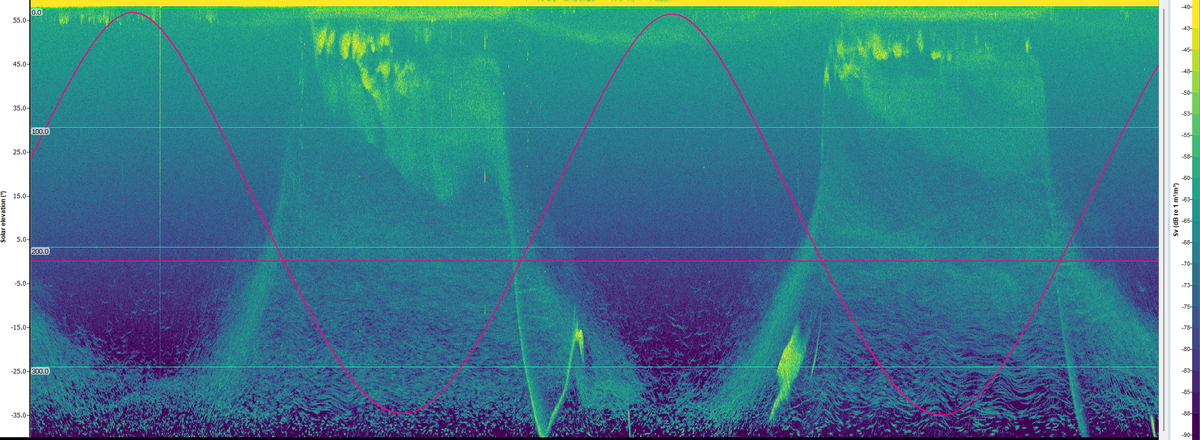
Time series can now be displayed directly on echograms, making it easier to compare acoustic observations with supporting measurements. In this example, Solar Elevation data has been overlaid on Nortek Signature 100 data to provide context for observed diel vertical migration patterns. The horizontal pink line marks 0° solar elevation, allowing day and night conditions to be identified at a glance.
Echoview 17 also introduces support for displaying multiple time series on a single graph, making it easier to compare variables, investigate trends, identify relationships, and understand how measurements change throughout a survey or deployment.
For users developing custom processing workflows, the Code operator can now generate time series outputs from custom Python-based calculations with Echoview's graphing, visualization, and analytical capabilities. Whether you're developing specialized algorithms or creating organization-specific workflows, custom outputs can now participate more naturally in Echoview's growing time series ecosystem.
Together, these enhancements make time series data a more integrated part of the Echoview experience, helping you bring more context into your workflows and gain deeper insight into your acoustic data.
Echoview 17 will be available for beta testing very soon, and will be officially released later in 2026.
Did you see our previous sneak peeks?
- Multiple detection configurations for schools and fish tracks
- Support for Tritech Gemini imaging sonar data
- New Dataflow tools
To be notified when new releases are available, please join our mailing list.