Empower the next generation of aquatic scientists
Today's employers are looking for more than academic knowledge. They want aquatic science graduates who can work with real instruments and real data.
Scientific echosounding is a fundamental technique for the study of aquatic ecosystems, yet few students have the opportunity to learn the required skills during their undergraduate or postgraduate studies.
Echoview training for higher education bridges that gap by:
- Helping universities enrich and differentiate their aquatic science curriculum
- Equipping students with practical, industry-relevant skills.

Scientific echosounding
Echosounders use reflected sound pulses to enable rapid, non-invasive exploration and monitoring of underwater environments with unrivalled resolution and coverage. Knowledge of echosounder theory and practice is therefore a core skill for those pursuing a career in aquatic ecosystem research.
Many scientists first encounter this specialized technology on the job, and face a steep learning curve with little to no formal support.
Echosounder theory is grounded in mathematics, electronics, hydroacoustics, and signal processing, making this one of the more challenging skillsets to master.
The path to proficiency takes time, and an aquatic scientist who has become familiar with the theory and practice of scientific echosounding over a period of systematic study, starting at university, will have a competitive edge in today’s job market.
Echoview training
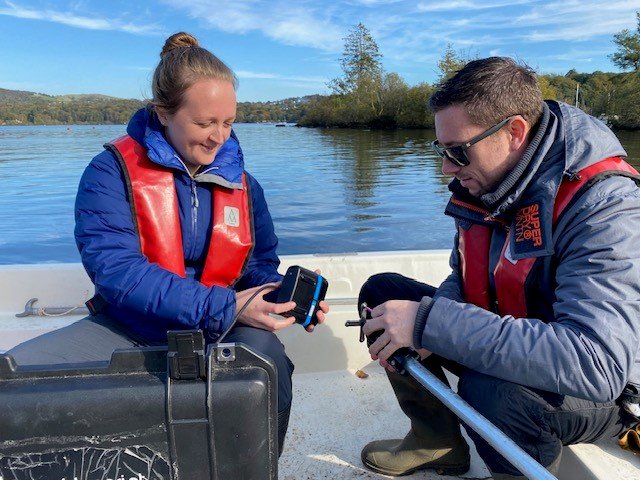
Echoview training for higher education offers undergraduate and postgraduate students a valuable opportunity to gain hands-on experience in the various aspects of scientific echosounding, including:
- Scientific applications of echosounding
- Echosounder theory
- Echosounder data processing using Echoview
- Incorporating echosounding into a program of research.
Echoview courses are designed in conversation with faculty, with each program customized to enrich an existing undergraduate or postgraduate curriculum. Delivery formats, timing, and duration are tailored to suit individual course requirements, and may range from guest lectures to intensive classroom and field-based workshops.

Our trainers
Echoview training is led by echosounding specialists from our science team, who deliver courses globally. Our trainers have deep domain knowledge of scientific echosounding and Echoview, and work regularly with the scientific community to provide training and technical support, conduct research, supervise students, and contribute to scientific publications, conferences, and international working groups. This ongoing involvement helps ensure our training reflects current science, emerging techniques, and industry best practice.

Why Echoview?
Echoview® is the industry standard software for single-beam and multibeam echosounder data processing. With over 30 years of development, Echoview is trusted and used in over 70 countries and supported by a dedicated team of scientists, software engineers, and sales staff.
Echoview is cited in a vast body of peer-reviewed literature, with applications including (but not limited to) fish stock assessment, fish passage monitoring, marine mammal ecology, zooplankton ecology, aquaculture monitoring, gas seep assessment, monitoring around renewable energy sites, and deep-sea research.
Higher education in practice
An ongoing collaboration with the University of Exeter shows how Echoview training can be integrated into a university aquatic science program.
Developed with faculty staff, the training introduces students to scientific echosounding using real echosounder data. Read the story here: Echoview and Exeter University | Echoview.
Frequently asked questions
More information
Interested in bringing scientific echosounding into your aquatic science curriculum? Echoview can work with you to develop training that supports your course goals and gives students practical experience with industry-standard tools and techniques.
Contact us to discuss your program, teaching needs, and training options.
Email: training@echoview.com
View our Echoview: Training for higher education brochure here.